
'This looks like a long-term bear market and there could be mounting losses in the near-term,' says Devangshu Datta.

It has been a choppy calendar year 2022 (CY22) for global financial markets amid the spectre of rising inflation that led most central banks, especially the US Federal Reserve (US Fed), to tighten their monetary policy. Most equity indices across the globe have seen a sharp fall from their respective peak levels in this backdrop. FTSE India, for instance, has corrected 16 per cent from its October peak.

The Indian startup ecosystem recently celebrated the 100th unicorn milestone. It came after a month of no big fund announcements. Compare this to 2021, when three to four unicorns were being added every month. Nevertheless, the 100th unicorn needs to be celebrated since the first unicorn was announced in 2011 - 11 years ago.

Analysts caution against volatility and recommend buying stocks of companies that are on strong fundamental footing that have been beaten down badly in the recent carnage.

The Fed interest rate decision, domestic macroeconomic data announcements and quarterly earnings will be the major sentiment drivers for the equity market in a holiday-shortened week ahead, analysts said. Investors will also take cues from the monthly auto sales numbers to be announced on Monday. Equity markets will remain closed on Thursday for Diwali Laxmi Pujan and on Friday for Diwali Balipratipada.
An action on the rate front is unlikely to figure in Rajan's plan for the moment.

The FMCG index gained more than 1% on the back of stellar gains in ITC.

Although there are serious risks facing the US economy in the coming year, there is also a good chance that growth will be substantially stronger than it has been since before the recession began.

Market breadth depicted gains with 1,476 advances over 1,403 declines on the BSE. 140 stocks remained unchanged.

The policy statement by the RBI governor is also expected to be upbeat.

'We suggest investors with suitable risk appetite to consider allocating 40-50 per cent in large-caps, 25-30 per cent of funds in quality mid and small-caps and the rest in debt and high yield products.'

'We would advise investors to invest in a disciplined way in equities for the long term.'

After three consecutive years of infusing huge funds, foreign portfolio investors retreated from the Indian equity markets in a big way in 2022 with the highest-ever yearly net outflow of nearly Rs 1.21 lakh crore. The huge outflow, which surpasses by a big margin the previous record of Rs 53,000 crore net withdrawal in 2008, came amid aggressive rate hikes by central banks globally but 2023 is expected to be better on positivity about overall macroeconomic trends in India, experts said. Apart from global monetary tightening, volatile crude, rising commodity prices along with Russia and Ukraine conflict led to an exodus of foreign money in 2022.

The Federal Reserve must now ensure that higher inflation doesn't derail the US recovery.

After turning net buyers last month, foreign investors have become aggressive shoppers of Indian equities and have invested Rs 22,452 crore in the first two weeks of August amid softening inflation concerns. This was way higher than a net investment of nearly Rs 5,000 crore by Foreign Portfolio Investors (FPIs) in the entire month of July, data with depositories showed. FPIs had turned net buyers for the first time in July, after nine straight months of massive net outflows, which started in October last year.

Total holdings of the top eight gold ETFs have risen by 3.8 million ounces so far this year

'Slower-than-anticipated recovery can be a bigger risk this time than a liquidity-driven event -- at least for India.'

In August, domestic equity markets garnered one of the highest foreign portfolio investor (FPI) flows since the outbreak of the pandemic in 2020, despite the US Federal Reserve standing firm on unwinding its stimulus measures to control inflation. FPIs pumped in over Rs 51,000 crore ($6.4 billion) in August, the most since December 2020 and the third-highest tally since March 2020-the month the Covid-19 pandemic roiled global markets. This was the second consecutive month of positive foreign flows. In the preceding nine months, FPIs had yanked out over $32 billion or Rs 2.2 trillion.

'The potential headwind is that the Indian economy is likely to see a slowdown in growth rates over the next two years.'

Urjit Patel as the new RBI governor whose focus is on taming inflation has lowered the probability of interest rate cut soon

RBI would get the comfort of meeting its 8 per cent January Consumer Price Index-based inflation target, BofA-ML said, adding that 'we expect the RBI to cut 75 bp in 2015 from February with inflation on course to 6 per cent in January 2016'.

Market benchmarks gave up intra-day gains to close in the red for the sixth session on the trot on Friday, capping a bruising week which saw a massive dash for safety amid rate hikes by global central banks and fears of slowing growth.

The broader NSE Nifty too fell below the 10,100 level by dropping 100.10 points to end at 10,094.25
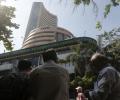
Reliance Industries was the top gainer in the Sensex pack, rising over 1 per cent, followed by M&M, HCL Tech, Axis Bank, ICICI Bank and HUL. On the other hand, Bharti Airtel, Maruti, SBI, PowerGrid, NTPC and Tata Steel were among the laggards.

Global markets trends, inflation, release of industrial output data and quarterly earnings will dictate movement of the equity benchmarks this week, analysts said, adding that volatility might continue amid slew of announcements of macroeconomic data at the global level too. Moreover, foreign fund movement, crude oil prices and trend in rupee would also act as major drivers for the equity market, they added. "The direction of global equity markets along with movement in dollar index and crude oil prices will continue to dominate while inflation numbers of the USA on May 11 and inflation and IIP numbers of India on May 12 will also cause volatility in the market," said Santosh Meena, head of research, Swastika Investmart Ltd.

Falling valuations, slowing funding rounds and faltering investor sentiment seem to have prompted many start-ups to lay off employees in a bid to conserve cash. The latest to do so is SoftBank-backed Cars24, a leading e-commerce platform for pre-owned vehicles, which has laid off over 600 staff, according to sources in the know. The move, they said, is aimed at conserving cash amid cautious investor sentiment and a slowdown in funding.

The winter session of Parliament will commence on November 26.

'Markets are factoring in a good show by India Inc in Q2.'

'If an investor is ready to stay put for the next five years, one can consider investing in mid- and small-cap funds, but through SIPs.'

Titan was the top loser in the Sensex pack, shedding over 3 per cent, followed by M&M, HUL, Maruti, Asian Paints and IndusInd Bank. Nifty fell 91 points to 17,157.40.

Stock market investors are expecting a balanced Budget with a focus on job creation, increased spending on infrastructure, reigning in the deficit, and bringing the economy back on track, experts said on Wednesday. Stock markets have been subdued in the run-up to the Union Budget with BSE's benchmark Sensex is almost flat so far this month. Even the corporate earning season failed to excite the markets, while some indices like IT and bankex have seen some positive movements.
The value of the foreign portfolio investors (FPI) holdings in the domestic equities reached $592 billion in three months ended June 2021, a surge of 7 per cent from the preceding quarter, according to a Morningstar report. This was largely on the back of robust net inflows from FPIs, coupled with the strong performance of the Indian equity markets. "As of the quarter ended June 2021, the value of FPI investments in Indian equities stood at $592 billion, which was considerably higher than the $552 billion recorded in the previous quarter, a spike of around 7 per cent," the report noted. As of June 2020, the value of FPI investments in Indian equities had been $344 billion.

'Avoid going overweight on gold. But maintain a 10 per cent allocation via sovereign gold bonds,' Bajaj Capital MD Sanjiv Bajaj tells Sarbajeet K Sen.

The deluge of offerings in the primary market, a muted results season and increasing talks of a Fed taper may quicken the pace of overseas investors selling Indian equities in the near term. The next few weeks may see a dozen companies tap the market for initial public offerings and raise about Rs 30,000 crore. These include the likes of Zomato, Glenmark Life Sciences, Utkarsh Small Finance Bank and Seven Islands Shipping.

Deal values have been falling steadily since May this year, when it touched a high of $851 million.

Bond issuances dipped 31.4% during January-June

'Markets should be driven more or less by earnings growth.'

Mr Modi might have questions to ask himself on the most formidable strategic challenge before India that he inherited from the United Progressive Alliance: The triangulation between China and Pakistan. The failure to break out of it, or even loosen it a bit, is something to reflect on, notes Shekhar Gupta.

'If the third wave of Covid infections is as bad as the second one, the market may get very polarised with a preference for blue-chips with low volatility.'

Bank credit growth, still sluggish, could see a rise if the Reserve Bank of India decides to cut interest rates, believes Ashima Goyal.
 © 2026 Rediff.com - Advertise with us - Disclaimer - Privacy Policy - Sitemap - Feedback - About us - Terms of use - Grievances